
Rio de Janeiro, Brazil
By Luminarama + Studio Draeger + Debora Bello, Brazil
In 1936, a team of young modernist architects — Oscar Niemeyer, Affonso Reidy, Jorge Moreira, Carlos Leão, and Ernani Vasconcelos — under the coordination of Lúcio Costa and the guidance of Le Corbusier, was tasked with creating a national architectural identity for what would become one of Brazil’s most iconic buildings: the Capanema Palace.
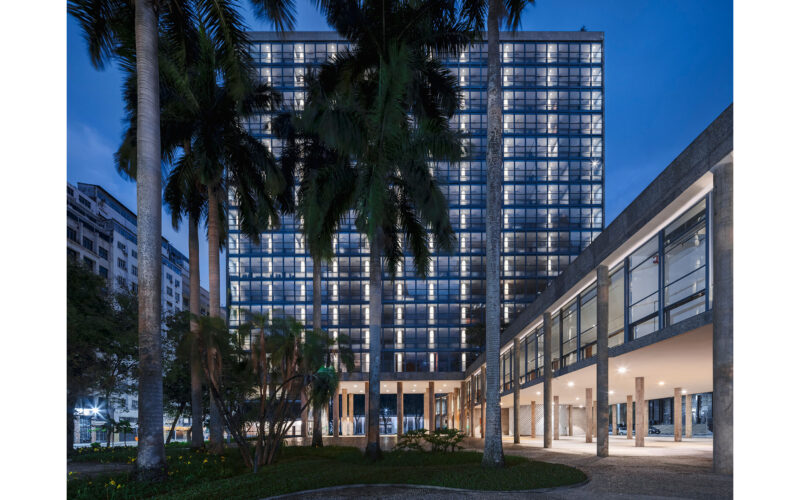
With its pilotis, free façade, ribbon windows, roof garden, and clean lines, the building embodies modernist principles adapted to Rio de Janeiro’s tropical context. More than 80 years later, a new team of architects and lighting designers — Christina Draeger, Débora Bello and Gabriel Vinagre — was entrusted with designing the lighting for this landmark, protected by the National Institute of Historic and Artistic Heritage (IPHAN).
In a listed modernist building, every intervention must be carefully measured. The project aimed to present the building as a unified whole, avoiding fragmented nighttime views while ensuring reversibility and respect for its original elements. The challenge was conceptual: how to introduce contemporary lighting into a building whose image has remained consistent for decades? The answer lay in aligning the lighting strategy with modernist principles.
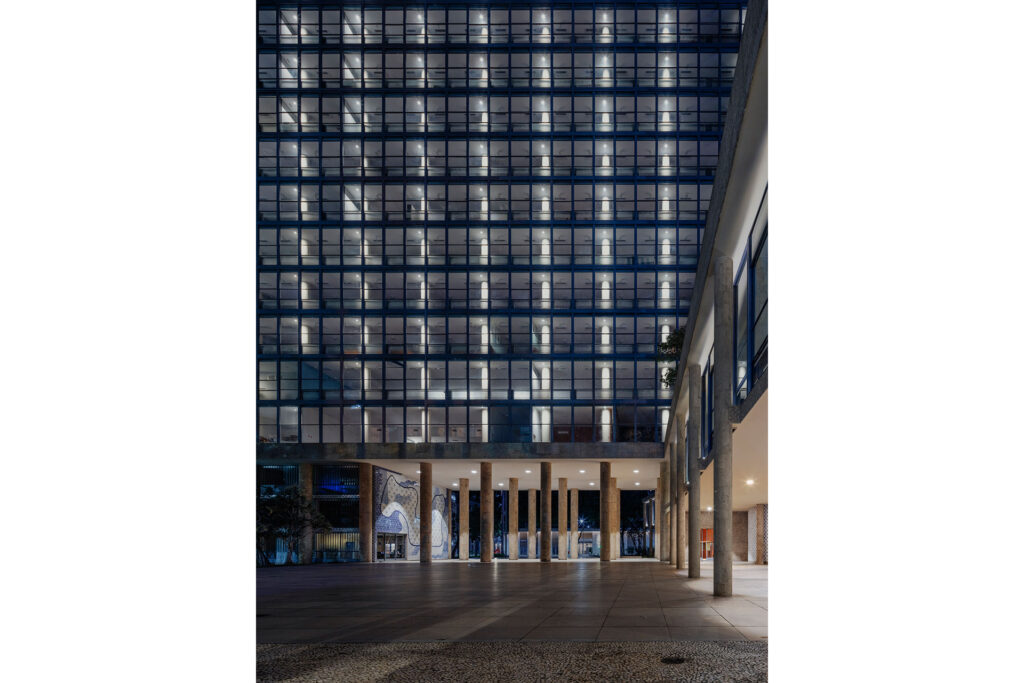
Modern architecture is rooted in permeability — enabled by reinforced concrete, open plans, pilotis, and transparent façades. The Palace expresses this through its open ground floor and contrasting façades. The north façade, defined by brise-soleil, reflects climatic adaptation and Brazilian identity; the glazed south façade has historically defined its nocturnal image.
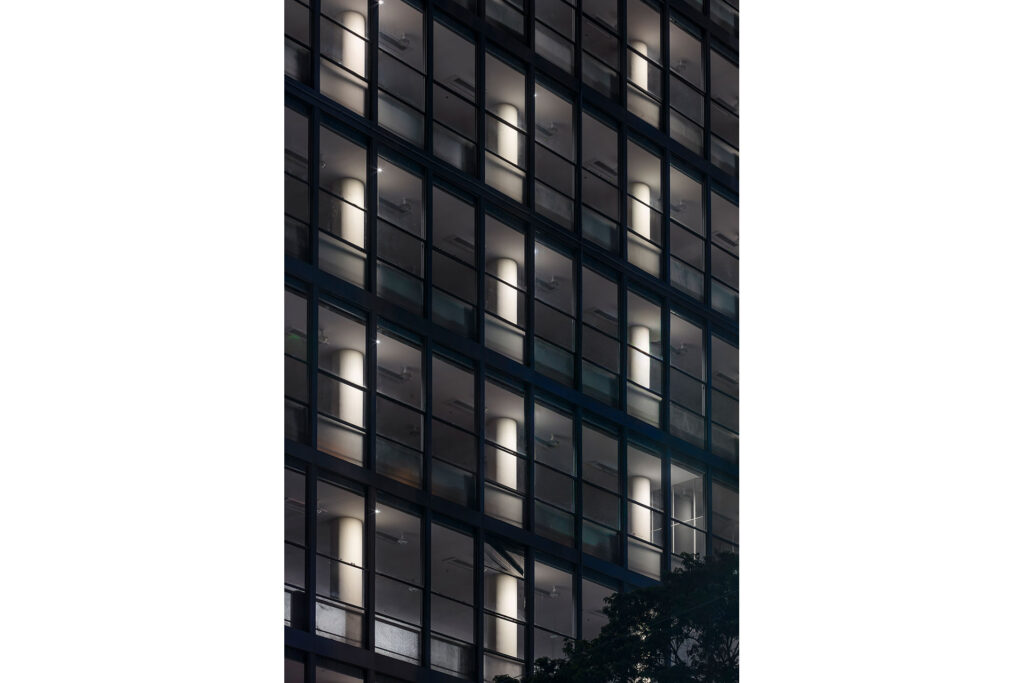
Guided by this interpretation, the main intervention illuminates the internal perimeter columns of the south façade with recessed wall-washer luminaires integrated into a plaster ceiling introduced during the air-conditioning upgrade. Rather than lighting the building as an object, the strategy reveals its spatial and structural logic, allowing light to act from the inside out. The intervention is discreet and precise, letting the architecture become the primary visual expression at night.
During the day, restored historic Holophane luminaires remain visible through the glass, preserving the original luminous identity. At night, light travels along the columns from the ground to the top floor, emphasiSing verticality and structural clarity.
The north façade remains mostly in semi-darkness, subtly defined at its base and crown. Sculptures and artworks — including murals by Candido Portinari — receive restrained, precise lighting, avoiding excessive emphasis in accordance with Lúcio Costa’s conception of the building as an integrated work. The gardens designed by Roberto Burle Marx remain unlit, preserving their intended relationship with natural light and shadow.
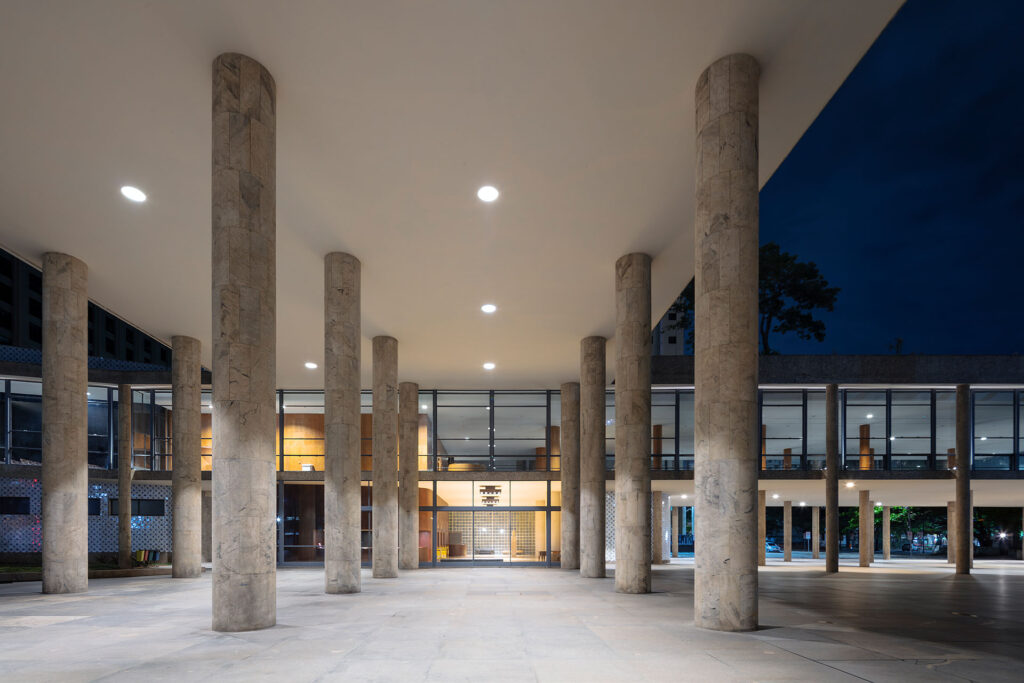
At ground level, where circulation flows freely beneath the pilotis, original recessed luminaires were preserved and retrofitted with compact contemporary light sources and precision optics integrated into the historic housings. This solution improved performance and visual comfort while maintaining scale, presence, and reversibility.
A 3000K coloUr temperature was adopted, approximating the historic incandescent character while respecting the building’s function as a workspace.
The result enhances the Palace’s nighttime presence while respecting its materiality, history, and established image, ensuring its continued relevance as a landmark of Brazilian and global modernism.